
Call us now
08045476623

 Send Inquiry
Shaping Machines
Price 300000 INR/ Unit
MOQ : 1 Unit
Shaping Machines Specification
- Machine Type
- Shaping Machine
- Drive
- V-belt Drive
- Frequency
- 50 Hz
- Operating Temperature
- 5C 40C
- Frame Type
- Heavy Duty Cast Iron
- Voltage
- 415 V
- Cooling System
- Water Cooled
- Connectivity Options
- Panel Mounted Controls
- Control System
- Manual/Automatic
- Production Capacity
- 5 - 15 pieces/hr
- Noise Level
- <75 dB
- Motor Power
- 3 HP
- Model No
- SM-400
- Lubricating System
- Centralized
- Power Rating
- 2.2 kW
- Accuracy
- 0.02 mm
- Features
- High Durability, Precise Shaping, Easy Operation
- Product Type
- Shaping Machine
- Technology
- Conventional
- Power Source
- Electric
- Operating Type
- Manual/CNC
- Power
- 3 HP
- Pressure
- Adjustable
- Surface Treatment
- Paint Coated
- Dimension (L*W*H)
- 1600 mm x 750 mm x 1100 mm
- Weight (kg)
- 900 kg
- Color
- Blue & White
- Usage & Applications
- Metal Shaping, Engineering Workshops, Tool Rooms
- Ram Travel
- 320 mm
- Main Motor RPM
- 1440 RPM
- Table Travel (Cross)
- 175 mm
- Maximum Stroke Length
- 300 mm
- Tool Slide Swivel
- 60°
- Table Travel (Longitudinal)
- 350 mm
- Clamping Device
- Provided
- Electrical Protection
- Overload Relay
- Table Size
- 450 x 250 mm
- Number of Feeds
- 6
- Standard Accessories
- Vice, Tools, Guard
Shaping Machines Trade Information
- Minimum Order Quantity
- 1 Unit
- Payment Terms
- Cash Advance (CA), Cash in Advance (CID)
- Supply Ability
- 10 Units Per Month
- Delivery Time
- 1 Week
- Sample Available
- Yes
- Sample Policy
- Sample costs shipping and taxes has to be paid by the buyer
- Main Export Market(s)
- Asia, Australia, Central America, North America, South America, Eastern Europe, Western Europe, Middle East, Africa
- Main Domestic Market
- All India, South India, Central India, West India, North India, East India, Gujarat, Karnataka, Kerala, Lakshadweep, Mizoram, Meghalaya, Manipur, Andhra Pradesh, Bihar, Chandigarh, Daman and Diu, Goa, Jharkhand, Odisha, Punjab, Assam, Delhi, Dadra and Nagar Haveli, Andaman and Nicobar Islands, Arunachal Pradesh, Chhattisgarh, Haryana, Himachal Pradesh, Jammu and Kashmir, Madhya Pradesh, Maharashtra, Nagaland, Rajasthan, Sikkim, Tamil Nadu, Telangana, Tripura, Pondicherry, Uttar Pradesh, Uttarakhand, West Bengal
About Shaping Machines
Sagar Machine Tools
Shaping machines are metalworking machines designed to cut and shape metal workpieces into specific forms and contours. These machines use a cutting tool, typically a single-point cutting tool, to remove material from the workpiece in a controlled manner. Shaping machines are widely used in manufacturing and machining processes for creating flat surfaces, grooves, slots, and other geometric shapes on metal parts.
Here are key features and aspects of shaping machines:
Principle of Operation: The basic principle of a shaping machine involves a reciprocating motion of the cutting tool and a continuous feed of the workpiece. The cutting tool removes material during the forward stroke, and the return stroke is non-cutting, allowing for repositioning.
Parts of a Shaping Machine:
Tool Head: The tool head holds the cutting tool and provides the necessary movement for shaping the workpiece.
Ram: The ram is the reciprocating part of the machine that carries the tool head. It moves back and forth to perform the cutting operation.
Table: The workpiece is mounted on the table, which can be adjusted vertically to accommodate different workpiece sizes.
Base: The base provides stability and support for the entire machine.
Types of Shaping Machines:
Horizontal Shaper: In a horizontal shaping machine, the workpiece is positioned horizontally on the table.
Vertical Shaper: In a vertical shaping machine, the workpiece is mounted vertically.
Tool Feed Mechanism: Shaping machines employ different mechanisms for feeding the cutting tool. This can include hydraulic, mechanical, or automatic feed mechanisms to control the depth and rate of the cutting.
Applications: Shaping machines are used for various applications, including creating flat surfaces, keyways, slots, grooves, and irregular profiles on metal workpieces. They are commonly used in the production of machine parts, gears, and components for machinery.
Automation: Some modern shaping machines may include automation features such as automatic tool adjustment, tool changing systems, and digital controls for increased precision and efficiency.
Advantages: Shaping machines are versatile and can be used for a variety of shaping operations on different materials. They are suitable for both small-scale workshops and large-scale manufacturing facilities. Shaping machines are relatively simple in design, making them easy to operate and maintain.
Limitations: Shaping machines may have slower cutting speeds compared to some other machining processes. The cutting tools geometry and limitations in shaping machine design may restrict the complexity of shapes that can be produced. Overall, shaping machines remain valuable in manufacturing processes where their specific capabilities meet the requirements of the workpieces being produced.
Precise and Versatile Metal Shaping
Engineered for accuracy, the SM-400 Shaping Machine boasts 0.02 mm precision, allowing for intricate metalwork in tool rooms and engineering workshops. Its 6-speed feed system facilitates versatility, handling various shaping tasks for small-batch or continuous production environments.
Operator-Friendly Controls and Safety Features
Equipped with panel-mounted controls, manual or automatic operation, and overload relay protection, this shaping machine prioritizes user safety and ease of use. The pressure is adjustable for optimal shaping results, and the tables large travels support complex workpieces.
Robust Construction and Long-Term Reliability
Crafted from heavy-duty cast iron and paint-coated for durability, the SM-400 withstands rigorous industrial use. Centralized lubrication and water cooling ensure smooth operation, while the included vice, tools, and guard provide immediate readiness for machining applications.
FAQs of Shaping Machines:
Q: How does the SM-400 shaping machine operate for different applications?
A: The SM-400 can operate in both manual and CNC automatic modes, making it suitable for diverse metal shaping tasks. Simply select the preferred mode using the panel controls and adjust the feed and pressure settings as needed for your specific workpiece.Q: What materials and industries are suitable for this shaping machine?
A: This shaping machine is ideal for engineering workshops, tool rooms, and general metalworking industries. It is designed primarily for shaping various metals, delivering high accuracy and efficiency across a range of production capacities.Q: When should I use the clamping device and standard accessories provided?
A: The clamping device and accessories like the vice and guard should be used whenever you are securing a workpiece on the table. This ensures firm holding during shaping operations, enhancing safety and the quality of the machined component.Q: Where can this shaping machine be installed and used most effectively?
A: The SM-400 is best suited for installation in industrial settings such as manufacturing shops, metalworking facilities, and educational institutions where robust, reliable metal shaping is required. Its compact footprint allows flexible placement in various workshop layouts.Q: What is the setup process for starting the shaping machine?
A: Begin by securing the workpiece with the vice or clamping device, select the desired speed and feed, and adjust the pressure to match the material. Ensure power connection (415V, 50Hz) and confirm water cooling and lubrication systems are functioning before commencing operation.Q: How does the centralized lubrication and water cooling system benefit the operation?
A: Centralized lubrication reduces maintenance needs, ensuring all moving components operate smoothly, while the water cooling system prevents overheating during continuous runs. These features work together to extend equipment life and maintain machining accuracy.Q: What are the key advantages of using the SM-400 shaping machine?
A: Key benefits include high durability, precise shaping (0.02 mm accuracy), easy operation via manual or automatic control, robust construction, and safety features like overload relay. Together, these attributes translate to enhanced productivity and reliable performance in demanding environments.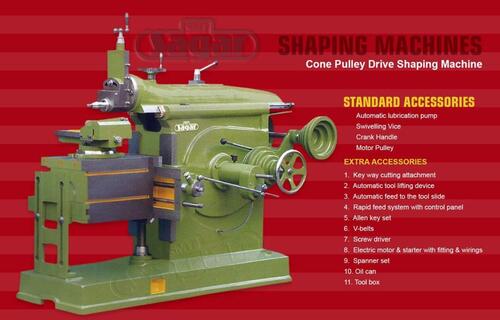
Tell us about your requirement

Price:
Quantity
Select Unit
- 50
- 100
- 200
- 250
- 500
- 1000+
Additional detail
Mobile number
Email


SAGAR MACHINE TOOLS
GST : 24EWJPS9029A1ZE
GST : 24EWJPS9029A1ZE
J.K Industrial Area, Survey No.149, Plot No.11, Kotda Sangani Main Road, Rajkot - 360022, Gujarat, India
Phone :08045476623

 Send Inquiry
- LATHE MACHINE
- Press Brake Machine
- Blade Grinding Machine
- Circle Cutting Machine
- Circular Saw Machine
- Industrial Drill Machine
- Jigsaw Machine
- Milling Cum Drilling Machine
- Pipe Bending Machine
- Section Bending Machine
- Shearing Machine
- Grinder
- Sheet Grooving Machine
- Welding Machine
- Air Compressor
- Pressure Pump
- Air Blower Machine
- Bench Grinder Machine
- Tapping Machinery
- Tapping Cum Drilling Machines
- Radial Drill Machinery
- Slotting Machines
- Hack Saw Machine
- Cutt Off Machine
- Concrete Block Cutting Machinery
- Milling Machinery
- Sander Machinery
- Glass Polishing Machine
- Shaping Machine
- Belt Grinding Machinery
- Bandsaw Machinery
- Turning And Facing
- Abrasive Belt Grinding
- Belt Grinder Polisher
- Hydraulic Press
- Power Press
- Press
- Hydraulic Multi Cutter Machine
- Stapler
- Jenny
 Send Inquiry
 Send SMS
SAGAR MACHINE TOOLS
All Rights Reserved.(Terms of Use)
Developed and Managed by Infocom Network Private Limited.
Developed and Managed by Infocom Network Private Limited.

