

Call us now
08045476623

 Send Inquiry
Pressure Pump
Price 7000 INR/ Unit
MOQ : 1 Unit
Pressure Pump Specification
- Flow Rate
- 200 L/min
- Pressure Capacity
- 8 Bar
- Noise Level
- 78 dB(A)
- Filtration Grade
- Standard
- Motor Power
- 2 HP
- Cooling Method
- Air Cooled
- Phase
- Single Phase
- Weight
- 70 Kg
- Drive Type
- Direct Drive
- Control System
- Automatic Pressure Switch
- Frequency
- 50 Hz
- Power Rating
- 1.5 kW
- Usage
- Industrial and Autombile Service Center
- Type Of Compressor
- Twin Piston Reciprocating
- Allied Equipment
- Pressure Gauge, Safety Valve, Air Filter
- Configuration
- Portable Horizontal
- Power Source
- Electric Driven
- Product Type
- Water Pressure Pump
- Silent
- No
- Color
- Red
- Lubrication Type
- Oil Lubricated
- Voltage
- 220-240 V
- Driven Mode
- Belt Driven
- Air Tank Capacity
- 100 Liters
- Pump Head
- 40 m
- Body Material
- Heavy Gauge Mild Steel
- Maximum Suction
- 8 m
- Pipe Connection Size
- 1/2 inch
Pressure Pump Trade Information
- Minimum Order Quantity
- 1 Unit
- Supply Ability
- 100 Units Per Month
- Delivery Time
- 1 Week
- Sample Available
- Yes
- Sample Policy
- Sample costs shipping and taxes has to be paid by the buyer
- Main Export Market(s)
- Asia, Australia, Central America, North America, South America, Eastern Europe, Western Europe, Middle East, Africa
- Main Domestic Market
- All India, South India, Central India, West India, North India, East India, Gujarat, Karnataka, Kerala, Lakshadweep, Mizoram, Meghalaya, Manipur, Andhra Pradesh, Bihar, Chandigarh, Daman and Diu, Goa, Jharkhand, Odisha, Punjab, Assam, Delhi, Dadra and Nagar Haveli, Andaman and Nicobar Islands, Arunachal Pradesh, Chhattisgarh, Haryana, Himachal Pradesh, Jammu and Kashmir, Madhya Pradesh, Maharashtra, Nagaland, Rajasthan, Sikkim, Tamil Nadu, Telangana, Tripura, Pondicherry, Uttar Pradesh, Uttarakhand, West Bengal
About Pressure Pump
Sagar Machine tools
Automobile Service Center used this pressure for wash vehicals
A pressure pump, also known as a pressure booster pump or simply a pump, is a device used to increase the pressure of a fluid, usually water. These pumps are commonly used in various applications to ensure adequate water pressure for domestic, industrial, agricultural, and commercial purposes.
Here are some key features and uses of pressure pumps:
Domestic Water Supply: Pressure pumps are often used in residential settings to boost water pressure, especially in houses where the municipal water supply or well water does not provide sufficient pressure.
Irrigation: In agriculture, pressure pumps are used to provide the necessary pressure for irrigation systems, ensuring that water reaches plants efficiently.
Commercial and Industrial Applications: Pressure pumps play a crucial role in industrial processes where consistent and controlled water pressure is essential for various operations.
Fire Protection Systems: Pressure pumps are used in fire protection systems to ensure an adequate and reliable supply of water for firefighting.
Car Wash Systems: Car wash facilities use pressure pumps to provide high-pressure water for cleaning vehicles efficiently.
Booster Systems: In buildings with multiple floors or in situations where the municipal water supply is insufficient, pressure pumps are used as part of booster systems to increase water pressure for upper-level floors.
Water Transfer: Pressure pumps are employed to transfer water from one location to another, such as from a storage tank to a distribution system.
Types of Pressure Pumps: Centrifugal Pumps: These are commonly used for domestic and industrial applications. They use an impeller to impart kinetic energy to the water, increasing its pressure.
Jet Pumps: These pumps use a combination of a centrifugal pump and a jet ejector to increase water pressure.
Positive Displacement Pumps: These pumps trap a fixed volume of fluid and then discharge it against the outlet pressure.
Variable Speed Pumps: Some pressure pumps come with variable speed settings, allowing for better control and energy efficiency by adjusting the pump speed based on demand. Automatic Pressure Control: Many pressure pumps are equipped with automatic pressure control systems that start and stop the pump as needed to maintain a consistent pressure level. When selecting a pressure pump, factors such as the required pressure, flow rate, power source (electric or gas), and the specific application should be considered. Regular maintenance is essential to ensure the pump's reliability and longevity. Additionally, it's crucial to follow the manufacturer's guidelines and recommendations for installation and operation.
Rugged Construction for Demanding Environments
Built from heavy gauge mild steel and finished in a vibrant red, this pressure pump is designed to withstand rigorous usage in industrial and auto service setups. The twin piston reciprocating mechanism ensures consistent airflow, making it suitable for heavy-duty applications requiring long-term reliability.
Efficient Performance Meets Versatility
Featuring a strong 2 HP belt-driven motor, 100-liter air tank, and direct drive system, the pump consistently delivers a flow rate of 200 L/min and supports a maximum pressure of 8 bar. Automatic pressure switch, safety valve, and air filter optimize the system for safety, efficiency, and easy operation.
FAQ's of Pressure Pump:
Q: How does the pressure pump maintain efficiency in industrial environments?
A: The pressure pump uses a twin piston reciprocating design with an oil-lubricated, air-cooled system to maintain efficient and reliable operation during intensive use. Its 100-liter air tank and robust 2 HP motor can sustain high flow rates and pressure with minimal downtime.Q: What safety and control features are included with this pressure pump?
A: The pump comes equipped with a pressure gauge, safety valve, air filter, and an automatic pressure switch, ensuring that operations remain safe and controlled. These features help prevent over-pressurization and maintain clean airflow during use.Q: When is this pump most suitable for use in service centers?
A: This pressure pump is ideal during high-demand periods when multiple pneumatic tools need to be powered efficiently. Its large tank capacity and rapid flow rate make it well-suited for continuous tasks such as inflating, spray painting, or operating air tools in automobile service centers.Q: Where can this pressure pump be installed, and how portable is it?
A: Thanks to its portable horizontal configuration and heavy-duty construction, the pump can be easily installed and repositioned within various industrial or service workshop settings. The compact design makes it convenient to move without sacrificing performance.Q: What is the operating process for this pressure pump?
A: To operate, connect the pump to a 220-240V single-phase power source, ensure oil levels are adequate, and adjust settings via the automatic pressure switch. The system will automatically regulate pressure flow and maintain optimal performance up to its 8 bar capacity.Q: What are the main benefits of using this pressure pump in industrial settings?
A: Key benefits include durable construction, reliable high-pressure output, efficient twin piston performance, versatile portability, and integrated safety mechanisms. These make it highly suitable for sustained and safe operation in both industrial and automotive service center environments.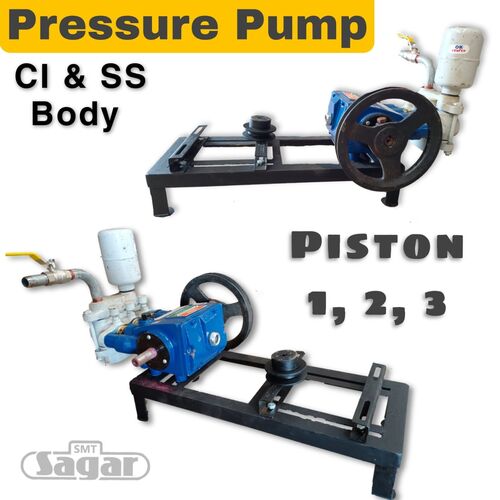
Tell us about your requirement

Price:
Quantity
Select Unit
- 50
- 100
- 200
- 250
- 500
- 1000+
Additional detail
Mobile number
Email


SAGAR MACHINE TOOLS
GST : 24EWJPS9029A1ZE
GST : 24EWJPS9029A1ZE
J.K Industrial Area, Survey No.149, Plot No.11, Kotda Sangani Main Road, Rajkot - 360022, Gujarat, India
Phone :08045476623

 Send Inquiry
- LATHE MACHINE
- Press Brake Machine
- Blade Grinding Machine
- Circle Cutting Machine
- Circular Saw Machine
- Industrial Drill Machine
- Jigsaw Machine
- Milling Cum Drilling Machine
- Pipe Bending Machine
- Section Bending Machine
- Shearing Machine
- Grinder
- Sheet Grooving Machine
- Welding Machine
- Air Compressor
- Pressure Pump
- Air Blower Machine
- Bench Grinder Machine
- Tapping Machinery
- Tapping Cum Drilling Machines
- Radial Drill Machinery
- Slotting Machines
- Hack Saw Machine
- Cutt Off Machine
- Concrete Block Cutting Machinery
- Milling Machinery
- Sander Machinery
- Glass Polishing Machine
- Shaping Machine
- Belt Grinding Machinery
- Bandsaw Machinery
- Turning And Facing
- Abrasive Belt Grinding
- Belt Grinder Polisher
- Hydraulic Press
- Power Press
- Press
- Hydraulic Multi Cutter Machine
- Stapler
- Jenny
 Send Inquiry
 Send SMS
SAGAR MACHINE TOOLS
All Rights Reserved.(Terms of Use)
Developed and Managed by Infocom Network Private Limited.
Developed and Managed by Infocom Network Private Limited.

